Why we recommend not more then 15 options to choose from lists in your Citizen Science app

Wednesday, 23 January 2019 16:43

When developing a Citizen Science app, you can influence usability in many ways. But these crucial decisions can be decisive factors when it comes down to whether they enjoy using it and do so regularly.

The setup of a Citizen Science app can make a great difference

Throughout of more than five years of continously improving the SPOTTERON platform, we optimized our user interface to a point where it is as simple as possible while still delivering all data needed. But many factors are still very individual for every single project.
In general, looks really do matter. Attractive Design is an important factor (Emotion & Design: Attractive things work better), that we enjoy tackling with our long-standing experience in the field, but that's not everything yet.

It is often said, that you can tell a good restaurant apart from a bad one by the number of choices on the menue. If there are very many, it's quite obvious that not all ingredients can be freshly stocked und quickly preparted at all times.

Why people prefer a manageable number of choices

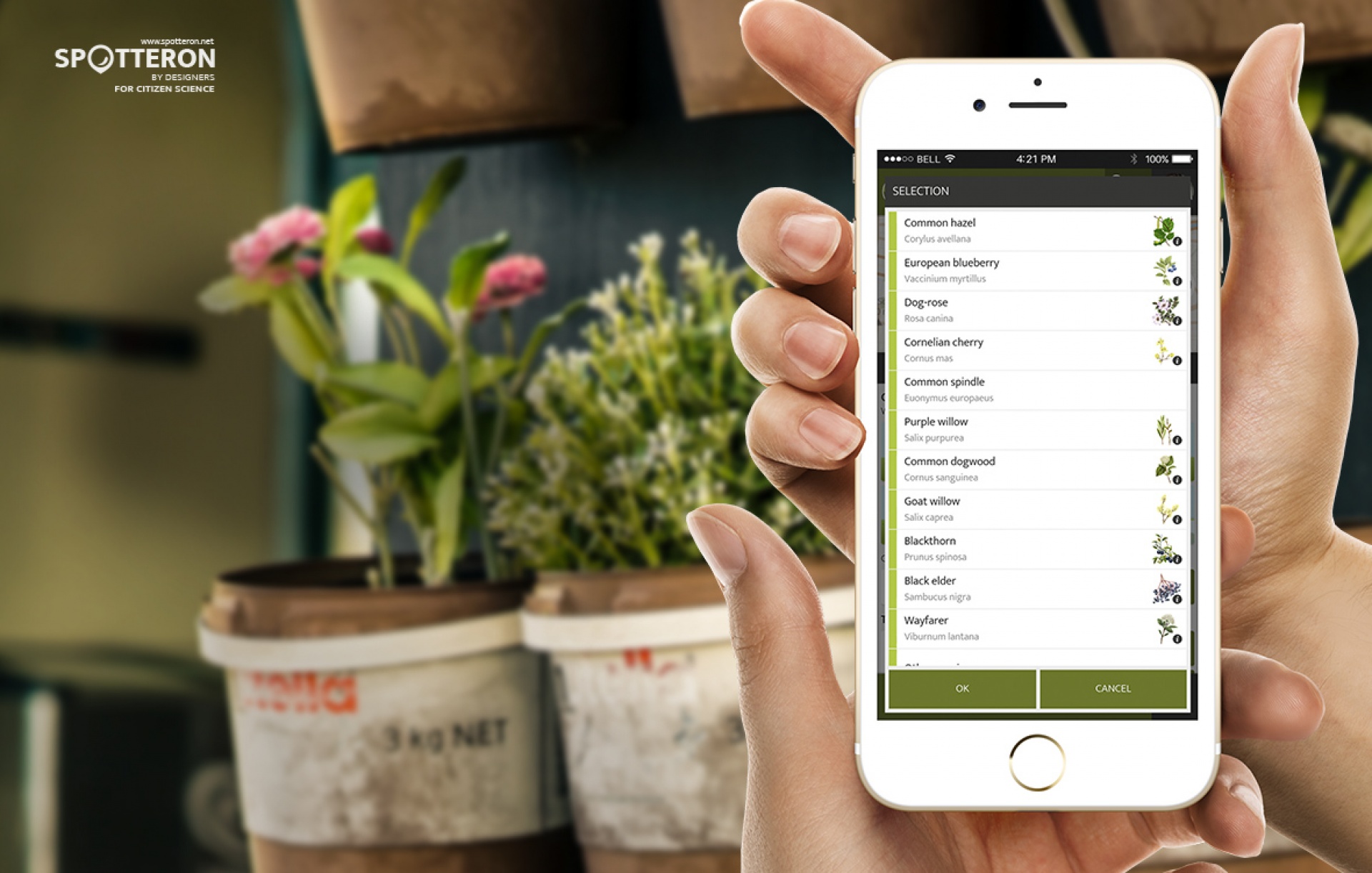
With Citizen Science apps, there are other reasons why we usually advise to rather keep it simple instead of overextending. On principle humans appreciate big varieties, but a list that is much too long can lead to exhaustion and disinterest. This phenomenon called "choice overload" was recently demonstrated in a study (1) by scientists of the California Institue of Technology (Caltech). It turns out that the human brain is not too excited about the additional expenditure of time which comes with large numbers of options. The interpretation of the research results suggests that a range of choices between 8 to 15 is optimal.

For these reasons it also makes sense not to give people an endless list of possible choices when it comes to Citizen Science apps. That could simply overextend users and ultimately lead to them submitting less data.

Of course we still leave final decisions on such topics to projects themselves, but it sure is good to know that science supports our recommendations.

(1) Choice overload reduces neural signatures of choice set value in dorsal striatum and anterior cingulate cortex
Elena Reutskaja, Axel Lindner, Rosemarie Nagel, Richard A. Andersen & Colin F. Camerer
Nature Human Behaviour volume 2, pages 925–935 (2018)

Interface Design in Citizen Science apps

For every project on the SPOTTERON platform we help to build a good and working structure of the project's data from a usability standpoint and put our interface design experience to use. Structuring a category tree which work well is an important task when planning a Citizen Science project.

Especially with the possibility to create hierarchical levels in the dialog for adding new observations, creating a structure which results in optimized selection lists is easy. With various elements, we are able to build a customized and tailored interface for your app, which can include selection lists along side with image buttons, which pre-filter a section of the project's data catgories - for example with pre-selecting "trees" in a phenology app users will just have the list of tree species to choose from as the next input step, not all species at once.

With around 15 selection options, the ideal amount of such a selection list is reached - if a selection list gets longer it is not catastrophic. But the longer it gets the more difficult it is for the Citizen Scientists to choose an option intuitively. As with many things in applied design, it's a reference value, not a strict rule.
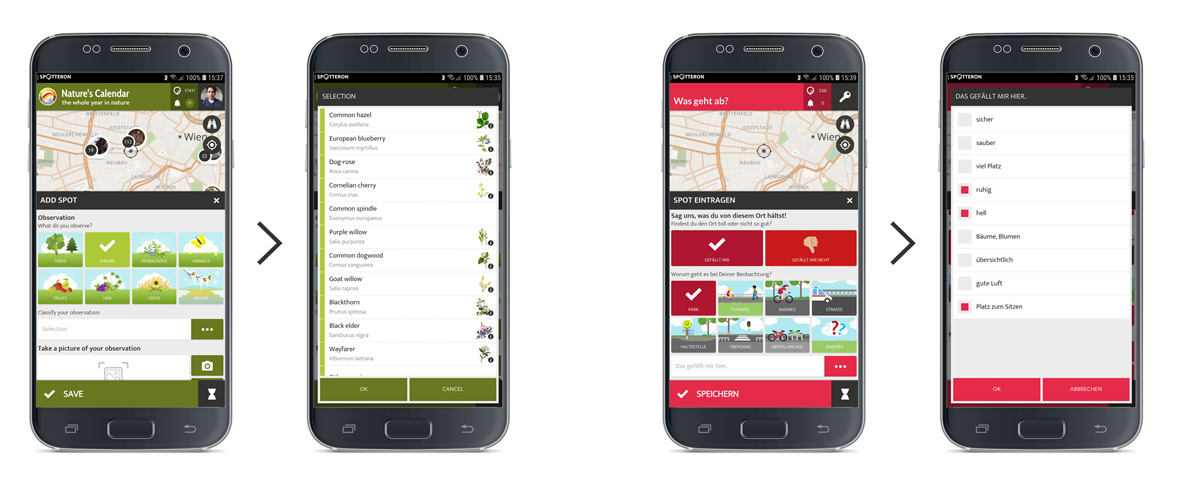
SPOTTERON 15Options SelectionLists Citizen Science Apps 01
Citizen Science Apps: "Nature's Calender ZAMG" - www.naturkalender.at, "Was geht ab?" - www.was-geht-ab.at


See live examples of Citizen Science apps on the SPOTTERON Platform

Example Horizon Europe / Horizon 2020 Collaborations

App Icon
Horizon 2020 Invasive Species Monitoring App

The IPM-Popillia Horizon 2020 project aims to address the challenge of a new risk to plant health in Europe's agriculture and food safety: the invasion of the Japanese Beetle, Popillia japonica. This invasive species was introduced accidentally to mainland Europe in 2014 and can quickly spread by transportation and trade. As a species with a wide range of feeding plants, P. japonica threatens the entire agricultural sector, urban landscapes, and biodiversity in invaded areas.

Learn more about
IPM Popillia | Integrated Pest Management of the Japanese Beetle
App Icon
Horizon Europe Citizen Science App

EFFECTIVE, a Horizon Europe initiative, targets the emerging threat to the EU's Mediterranean Blue Natural Capital. By leveraging advanced science, technological nature-based solutions, digitalization, and social implication, the project aims to develop a comprehensive scientific knowledge base and practical guidance for the application of Ecosystem-Based Management to promote large-scale marine protected areas establishment in the European seas.

Learn more about
EFFECTIVE | Protection and Restoration Management of Mediterranean Marine Protected Areas
App Icon
Horizon Europe Citizen Science App

TRANSEATION, funded by Horizon Europe, aims to validate a new level of ecosystem-based management by integrating social implication digitalization and nature-based solutions to safeguard and restore marine ecosystem health and services. The project focuses on demonstrating the effectiveness of marine and coastal hybrid blue-grey infrastructures and developing digital tools for monitoring, analysis, and social involvement, addressing societal challenges and promoting sustainable management practices.

Learn more about
TRANSEATION | Advancements through Hybrid Blue-Grey Infrastructures in Marine and Coastal Areas
App Icon
Horizon 2020 Citizen Social Science App

In Europe and globally, substantial numbers of young people are at risk of social exclusion. Therefore, there is a pressing need to develop more knowledge and innovation to create inclusive and youth-friendly societies. The Horizon 2020 R&I Project YouCount contributes to these needs by developing 'actionable' knowledge for social inclusion of disadvantaged youths in the European Union and creating better means for social inclusion through citizen social science.

Learn more about
YouCount | Youth Citizen Science
App Icon
Horizon 2020 Citizen Science App

The impact of plastic pollution on soil health is largely unknown. However, the amounts of plastic entering soils are equal to or possibly even more significant than those entering our rivers, seas, and oceans. MINAGRIS, an EU Horizon 2020 funded project, will investigate how plastic affects soil biodiversity, soil functions, associated ecosystem services, and agricultural productivity.
Learn more about
MINAGRIS | Micro and Nanoplastics in Agricultural Soils
App Icon
Health Citizen Science App
University Medical Center Schleswig-Holstein, Kiel University Institute of Medical Psychology and Medical Sociology

StreetMind contributes to a better understanding how environmental factors like urbanicity or climate change influence how individuals across Europe and the world feel, act, and behave. Participants make up their minds with fellow citizens and scientists and share their daily experiences of their surroundings and the environment where they live, work, and interact.

Learn more about
StreetMind

Short News

  • New study from BiciZen project: "BiciZen: Lessons in the Development of a Crowdsourcing Mobile App to Make Cities More Bikeable" published in Journal of Participatory Research Methods. More studies available under the publication page here.

    in Shortnews
  • Roadkill project has made wonderful short videos for the citizen scientists! The videos include the Roadkill App functions regarding how to confirm & comment on the spots and how to best take the photos for the project. The videos (in German) are available in the "Österreich forscht" blog here. 

    in Shortnews

Newsletter

Please enable the javascript to submit this form