The birds that were close to extinction in the 1930s can now be spotted in cities like Sydney or Brisbane. Their spreading into people’s backyards is probably also due to them gaining legal protection in the 1970s. What makes them rather unpleasant guests for well groomed garden areas is their unique reproductive behaviour: instead of using their body heat to breed their eggs, the males build massive mounds of up to 3 tonnes of weight in which they bury and then leave their eggs. After the hatching they are mostly left to themselves, this makes it quite astonishing, that even though cities should be quite dangerous playgrounds to these newborns, the population is still on the rise especially in these areas.
That’s why the Taronga Conservation Society, the Royal Botanic Garden and the University of Sydney now want to team up with Citizen Scientists to collect data on sightings and thereby better understand both their population dynamics and social behaviour.
For the data collection, sightings of brush turkeys (grownups and chicks), their mounds, roosts and other traces are added via the Citizen Science apps for Android and iOS or the interactive browser map.
PhD Student Matt Hall won the SPOTTERON Competition of the Australian Citizen Science Conference with this project this year and will collect data with the help of the apps for at least two years. We are very exited what conclusions will be drwan and invite all Australians (or visitors of Australia) to participate in this project!
A new addition to the platform - Welcome Brushturkeys
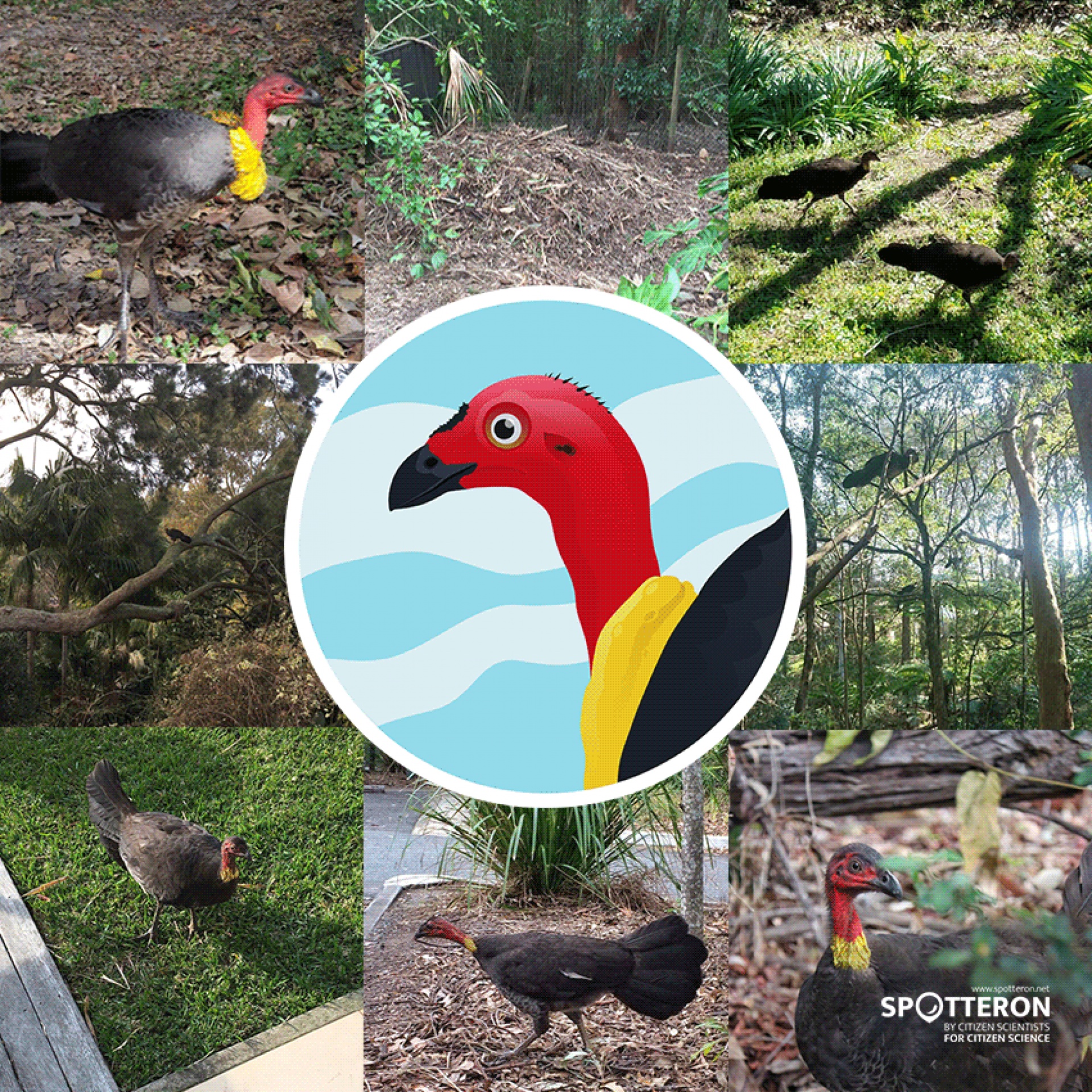
We are happy to welcome a new project to the SPOTTERON platform this month. As you can tell by the name, „Brushturkeys - birds in suburbia“ is all about Australian Brushturkeys extending their natural habitat, which usually includes rainforests and woodlands, to suburban areas.
Example Horizon Europe / Horizon 2020 Collaborations


The IPM-Popillia Horizon 2020 project aims to address the challenge of a new risk to plant health in Europe's agriculture and food safety: the invasion of the Japanese Beetle, Popillia japonica. This invasive species was introduced accidentally to mainland Europe in 2014 and can quickly spread by transportation and trade. As a species with a wide range of feeding plants, P. japonica threatens the entire agricultural sector, urban landscapes, and biodiversity in invaded areas.
IPM Popillia | Integrated Pest Management of the Japanese Beetle



EFFECTIVE, a Horizon Europe initiative, targets the emerging threat to the EU's Mediterranean Blue Natural Capital. By leveraging advanced science, technological nature-based solutions, digitalization, and social implication, the project aims to develop a comprehensive scientific knowledge base and practical guidance for the application of Ecosystem-Based Management to promote large-scale marine protected areas establishment in the European seas.
EFFECTIVE | Protection and Restoration Management of Mediterranean Marine Protected Areas



TRANSEATION, funded by Horizon Europe, aims to validate a new level of ecosystem-based management by integrating social implication digitalization and nature-based solutions to safeguard and restore marine ecosystem health and services. The project focuses on demonstrating the effectiveness of marine and coastal hybrid blue-grey infrastructures and developing digital tools for monitoring, analysis, and social involvement, addressing societal challenges and promoting sustainable management practices.
TRANSEATION | Advancements through Hybrid Blue-Grey Infrastructures in Marine and Coastal Areas


In Europe and globally, substantial numbers of young people are at risk of social exclusion. Therefore, there is a pressing need to develop more knowledge and innovation to create inclusive and youth-friendly societies. The Horizon 2020 R&I Project YouCount contributes to these needs by developing 'actionable' knowledge for social inclusion of disadvantaged youths in the European Union and creating better means for social inclusion through citizen social science.
YouCount | Youth Citizen Science



MINAGRIS | Micro and Nanoplastics in Agricultural Soils



StreetMind contributes to a better understanding how environmental factors like urbanicity or climate change influence how individuals across Europe and the world feel, act, and behave. Participants make up their minds with fellow citizens and scientists and share their daily experiences of their surroundings and the environment where they live, work, and interact.
StreetMind