Citizen Science & Communication: Send Direct Messages in your SPOTTERON CitSci App

Wednesday, 23 August 2017 14:50

Citizen Science is also about communication. With the upcoming direct message feature we release the first part of a series of SPOTTERON extensions, bringing projects and participants closer together.. 

 
HOW DOES IT WORK?

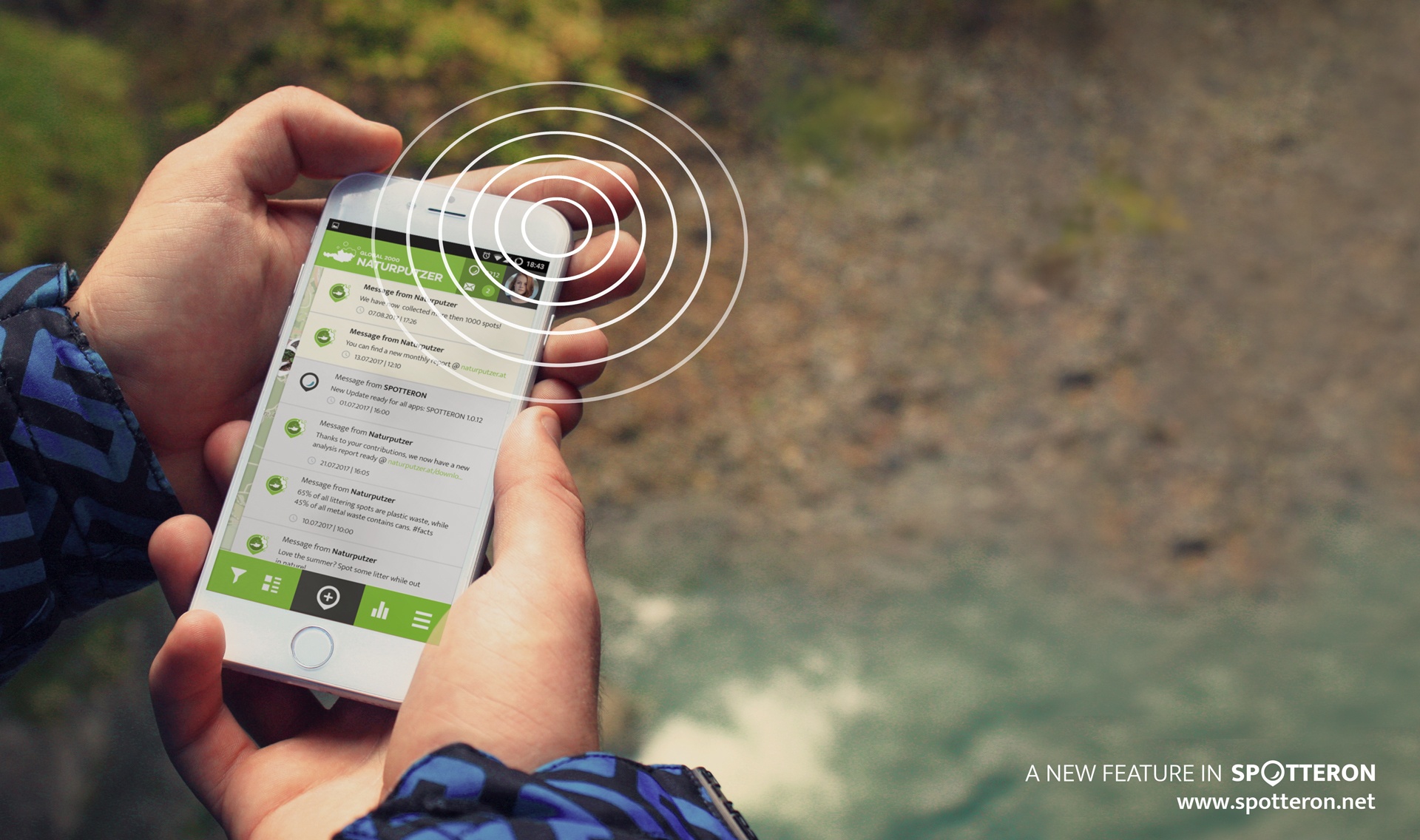
This major extension allows all Citizen Science projects in SPOTTERON to send short messages directly to all smartphones of the Citizen Scientists. The messages can contain up to 140 characters like e.g. Twitter and links to the web, which are automatically shortend.

After sending a new message in the administration interface of the project, the smartphones of the Citizen Scientists will instantly make a sound. All phones display a new notification in the status bar. Regarding the operating system version, it is predefined how the notification message will look. Here an example in Android 7:
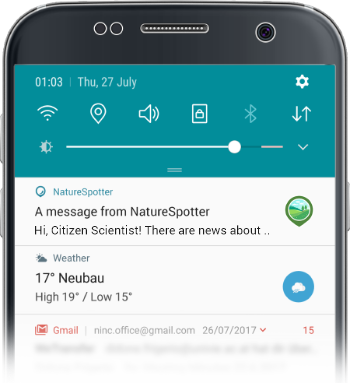
 

spotteron direct messaging notifications4


By tapping the notification, the Citizen Scienc smartphone app of the project opens up. It displays automatically the message panel with the newest messages on top, which are additionally highlighted.

We also implemented a new message counter in the top bar below the spot counter, so users can easily access the message panel and instantly see if there are unread messages.
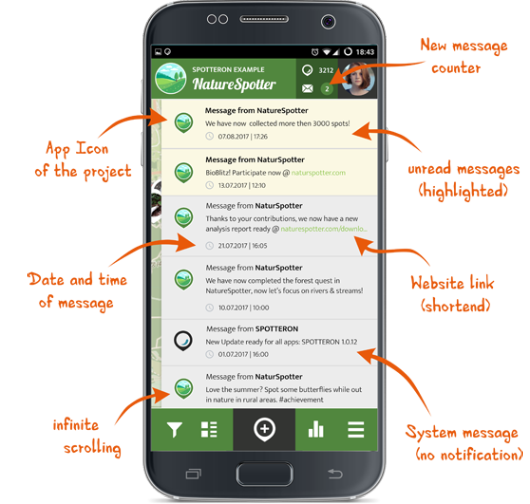
 

spotteron direct messaging messages phone3


CITIZEN SCIENCE & COMMUNICATION

With this brand new feature, all Citizen Science projects in SPOTTERON can reach out to the participants, inform about developments and get directly in contact with their user base.

Citizen Science always should give something back to the Citizen Scientists and by having a strong messaging feature ready, projects in SPOTTERON can now get the word out for higher involvement and interactivity.

The new "Direct Messaging" feature is now available for all projects running in the SPOTTERON Citizen Science platform.

     
NEW PROJECTS IN SPOTTERON
     
During summer, new Citizen Science projects joined up in the SPOTTERON Citizen Science plattform.
     
FK xhdpi  

phenology
Fjällkalendern

This new Citizen Science project about artic phenology by the University of Stockholm in Sweden invites visitors of the science trail along the mountain Nuolja/Njullà to help with climate change research.

Scope: regional
Country: Sweden, EU
Partner: University of Stockholm
Website: naturenskalendern.se

     
 FB 96x96  

biodiversity
Fagelbär (Birds & Berries)

In this Citizen Science App for the University of Stockholm in Sweden, Citizen Scientists are doing observations about which bird species are feeding on various trees and their berries in the wild.

Scope: nationwide
Country: Sweden, EU
Partner: University of Stockholm
Website: su.se/deep


WGA 96x96

transportation science
Was geht ab? (What's going on?)

This project by the Institute of Transport Studies of the University of Life Science, Vienna works with school classes to research the surroundings of Viennese schools and the impact on the pupils daily life.

Scope: regional
Country: Austria, EU
Partner: University of Natural Resources & Life Sciences Vienna
Website: was-geht-ab.at

     
    You can find all SPOTTERON Apps here:
www.spotteron.net/apps


more Info about SPOTTERON

Interested in modern Citizen Science tools?
GET SPOTTERON 1.0 FOR YOUR OWN CITIZEN SCIENCE PROJECT

SPOTTERON is designed by Citizen Scientists for Citizen Science. We provide a stable and reliable solution for your custom #CitizenScience smartphone apps and interactive maps for your project's homepage with ongoing updates and support..

For further questions about SPOTTERON - the Citizen Science System please don't hesitate to add "spotteron" on Skype or drop us an eMail at This email address is being protected from spambots. You need JavaScript enabled to view it..

Example Horizon Europe / Horizon 2020 Collaborations

App Icon
Horizon 2020 Invasive Species Monitoring App

The IPM-Popillia Horizon 2020 project aims to address the challenge of a new risk to plant health in Europe's agriculture and food safety: the invasion of the Japanese Beetle, Popillia japonica. This invasive species was introduced accidentally to mainland Europe in 2014 and can quickly spread by transportation and trade. As a species with a wide range of feeding plants, P. japonica threatens the entire agricultural sector, urban landscapes, and biodiversity in invaded areas.

Learn more about
IPM Popillia | Integrated Pest Management of the Japanese Beetle
App Icon
Horizon Europe Citizen Science App

EFFECTIVE, a Horizon Europe initiative, targets the emerging threat to the EU's Mediterranean Blue Natural Capital. By leveraging advanced science, technological nature-based solutions, digitalization, and social implication, the project aims to develop a comprehensive scientific knowledge base and practical guidance for the application of Ecosystem-Based Management to promote large-scale marine protected areas establishment in the European seas.

Learn more about
EFFECTIVE | Protection and Restoration Management of Mediterranean Marine Protected Areas
App Icon
Horizon Europe Citizen Science App

TRANSEATION, funded by Horizon Europe, aims to validate a new level of ecosystem-based management by integrating social implication digitalization and nature-based solutions to safeguard and restore marine ecosystem health and services. The project focuses on demonstrating the effectiveness of marine and coastal hybrid blue-grey infrastructures and developing digital tools for monitoring, analysis, and social involvement, addressing societal challenges and promoting sustainable management practices.

Learn more about
TRANSEATION | Advancements through Hybrid Blue-Grey Infrastructures in Marine and Coastal Areas
App Icon
Horizon 2020 Citizen Social Science App

In Europe and globally, substantial numbers of young people are at risk of social exclusion. Therefore, there is a pressing need to develop more knowledge and innovation to create inclusive and youth-friendly societies. The Horizon 2020 R&I Project YouCount contributes to these needs by developing 'actionable' knowledge for social inclusion of disadvantaged youths in the European Union and creating better means for social inclusion through citizen social science.

Learn more about
YouCount | Youth Citizen Science
App Icon
Horizon 2020 Citizen Science App

The impact of plastic pollution on soil health is largely unknown. However, the amounts of plastic entering soils are equal to or possibly even more significant than those entering our rivers, seas, and oceans. MINAGRIS, an EU Horizon 2020 funded project, will investigate how plastic affects soil biodiversity, soil functions, associated ecosystem services, and agricultural productivity.
Learn more about
MINAGRIS | Micro and Nanoplastics in Agricultural Soils
App Icon
Health Citizen Science App
University Medical Center Schleswig-Holstein, Kiel University Institute of Medical Psychology and Medical Sociology

StreetMind contributes to a better understanding how environmental factors like urbanicity or climate change influence how individuals across Europe and the world feel, act, and behave. Participants make up their minds with fellow citizens and scientists and share their daily experiences of their surroundings and the environment where they live, work, and interact.

Learn more about
StreetMind

Short News

  • New study from BiciZen project: "BiciZen: Lessons in the Development of a Crowdsourcing Mobile App to Make Cities More Bikeable" published in Journal of Participatory Research Methods. More studies available under the publication page here.

    in Shortnews
  • Roadkill project has made wonderful short videos for the citizen scientists! The videos include the Roadkill App functions regarding how to confirm & comment on the spots and how to best take the photos for the project. The videos (in German) are available in the "Österreich forscht" blog here. 

    in Shortnews

Newsletter

Please enable the javascript to submit this form