This was the Vienna Ball of Sciences 2019 - with video!

Tuesday, 05 February 2019 19:56

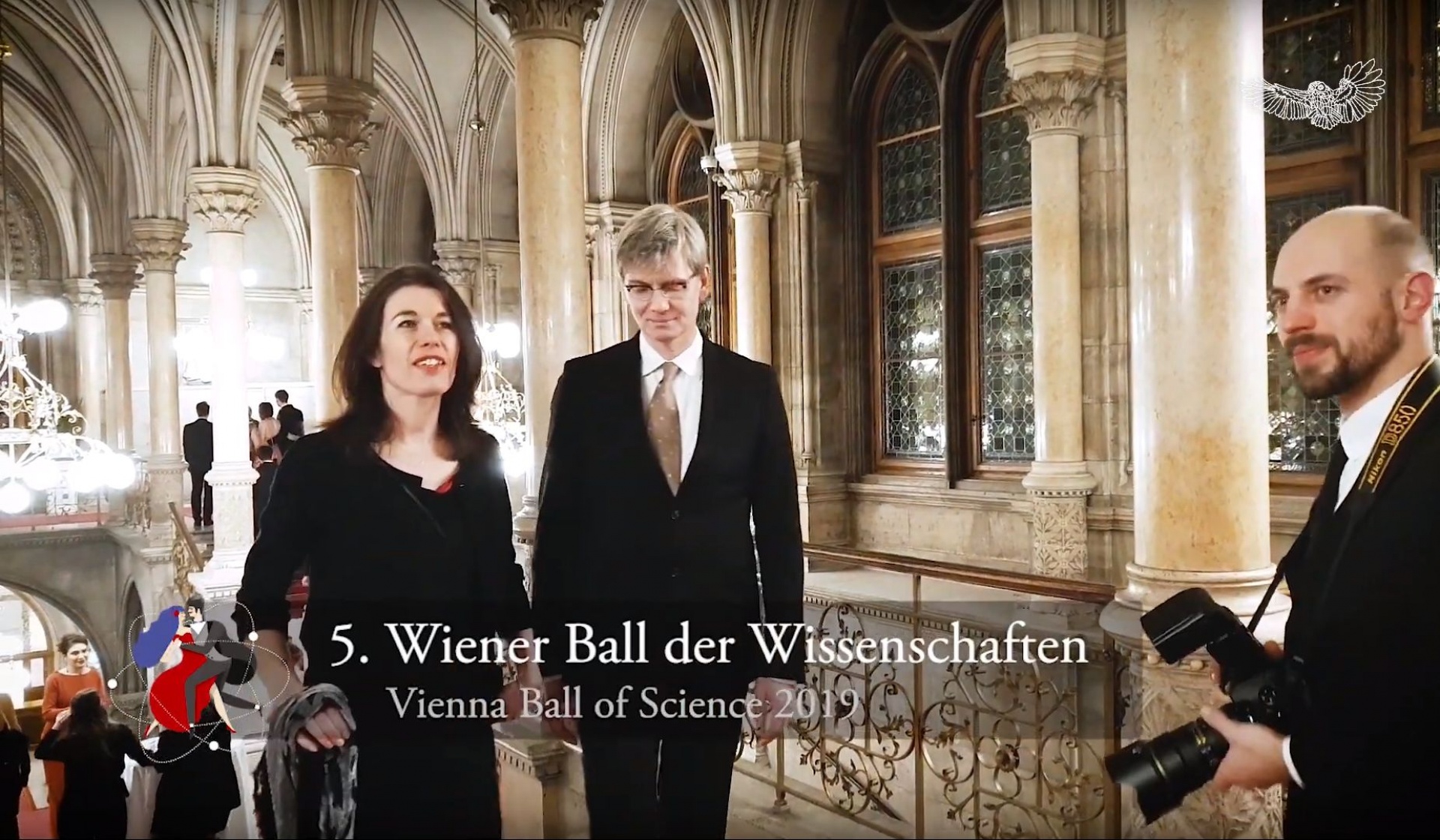
On the 25th of January 2019 the Vienna City Hall hosted the Vienna Ball of Sciences for the 5th time, held under the motto: “Waltz and Science". As Citizen Scientists from SPOTTERON it was a great pleasure, that we had been invited to film the event just as we did the year before.

Among the participants at the ball were scientists from all over the world. Beside others, we were able to film the Scientist of the Year Nuno Maulide, the Nobel Prize winner Robert Huber (Chemistry 1988), as well as many other well-known scientists swinging their dancing legs. The different backgrounds of the guests, the incomparable ambience of the Vienna City Hall and, last but not at least, the extremely varied programme of the ball made this evening an unforgettable experience for us.
As Citizen Scientists we were very happy to participate in an event, where beside wild dances, great music with dance interludes and the great ambience, everything was about science.

After we had prepared our equipment, the evening started, as in the last year, with the reception on red carpet of many well-known, but also new faces. After the official inauguration of the evening with speech by the chairman of the ball committee, Oliver Lehmann, and a speech of the mayor Dr. Michael Ludwig, the young ladies and gentlemen from the dance academy Kraml danced into the ceremonial hall, in order to inaugurate the evening with their Polonaise.
Afterwards we accompanied mayor Dr. Michael Ludwig and the former mayor Dr. Michael Häupl, biologist and president of the WWTF ("Viennese Science-, Research- und Technology-Fund"), on their tour through the different stages of the ball. There is one thing we could be certain about: The visitors of the Ball were definitely not bored during dance breaks on this evening.

The entertainment and presentations ranged from tasty samples of local superfoods, selected by Karl-Heinz Wagner, Professor of Nutrition Science at the University of Vienna, 3D-projections of the Vienna Center or Logic and Algorithms of the TU Vienna, virtual walks through the magical gardens of Gustav Klimt, made possible by the “Museum für Angewandte Kunst” MAK in cooperation with the multimedia artist Fred Baker, trough to a roulette table of the Casino Austria benefitting the refugee project “MORE”.

Midnight Interlude

At 00:00, Kalyi Jag, the most legendary Roma band in Hungary, presented by Ursula Hemetek, winner of the Wittgenstein Prize and ethnomusicologist, firing up the guests in the ceremonial hall.
After this moody concert the evening continued with the midnight quadrille, where even the not so enthusiastic dancers among the guests could not avoid to get up to join the dancing crowd. Due to the wonderful music of the Orchestra of the Private University for Music of Vienna and the Ball Orchestra Divertimento Viennese, nomerous couples remained on the dance floor and turned the ceremonial hall into a colourful sea of swinging ball robes and dancing legs floating above the floor.

We experienced an incredible atmosphere at 1:00 a.m. in the discotheque, when the Viennese rap-duo ESRAP made the crowd at Volkshalle, designed by students of the Academy of Fine Arts Vienna with a 30 meter long fluorescent painting, bouncing to their vibes.
Even we, the Citizen Science team from SPOTTERON, struggled very hard to stand still while trying to hold our cameras focussed.
We didn’t grab just the dancing mayor Dr. Michael Ludwig, but also the ball ambassador Prof. Franz Kerschbaum, Professor for Astronomy at the University of Vienna, who was looking for the hottest dancers with his thermal imaging camera, while swinging their dancing legs.
After raging applause and an encore the party went on with some cool music from the Djs.

Our video clip of the 5. Vienna Ball of Sciences:

When we stepped out through the gates of the town hall at the end of the evening, a waiter passed by with a beverage trolley, creating a sound comparable to disco beats. Immediately some visitors who had just left the party started to applaud: “Encore, encore, let's dance a little bit more!", we were probably not the only ones for whom this wonderful evening has gone by too soon. With anticipation we are now looking forward to the 6th Vienna Ball of Science on 25. 1. 2020. Until then we let our official ball video carry us back to the ball and float in memories.


Example Horizon Europe / Horizon 2020 Collaborations

App Icon
Horizon 2020 Invasive Species Monitoring App

The IPM-Popillia Horizon 2020 project aims to address the challenge of a new risk to plant health in Europe's agriculture and food safety: the invasion of the Japanese Beetle, Popillia japonica. This invasive species was introduced accidentally to mainland Europe in 2014 and can quickly spread by transportation and trade. As a species with a wide range of feeding plants, P. japonica threatens the entire agricultural sector, urban landscapes, and biodiversity in invaded areas.

Learn more about
IPM Popillia | Integrated Pest Management of the Japanese Beetle
App Icon
Horizon Europe Citizen Science App

EFFECTIVE, a Horizon Europe initiative, targets the emerging threat to the EU's Mediterranean Blue Natural Capital. By leveraging advanced science, technological nature-based solutions, digitalization, and social implication, the project aims to develop a comprehensive scientific knowledge base and practical guidance for the application of Ecosystem-Based Management to promote large-scale marine protected areas establishment in the European seas.

Learn more about
EFFECTIVE | Protection and Restoration Management of Mediterranean Marine Protected Areas
App Icon
Horizon Europe Citizen Science App

TRANSEATION, funded by Horizon Europe, aims to validate a new level of ecosystem-based management by integrating social implication digitalization and nature-based solutions to safeguard and restore marine ecosystem health and services. The project focuses on demonstrating the effectiveness of marine and coastal hybrid blue-grey infrastructures and developing digital tools for monitoring, analysis, and social involvement, addressing societal challenges and promoting sustainable management practices.

Learn more about
TRANSEATION | Advancements through Hybrid Blue-Grey Infrastructures in Marine and Coastal Areas
App Icon
Horizon 2020 Citizen Social Science App

In Europe and globally, substantial numbers of young people are at risk of social exclusion. Therefore, there is a pressing need to develop more knowledge and innovation to create inclusive and youth-friendly societies. The Horizon 2020 R&I Project YouCount contributes to these needs by developing 'actionable' knowledge for social inclusion of disadvantaged youths in the European Union and creating better means for social inclusion through citizen social science.

Learn more about
YouCount | Youth Citizen Science
App Icon
Horizon 2020 Citizen Science App

The impact of plastic pollution on soil health is largely unknown. However, the amounts of plastic entering soils are equal to or possibly even more significant than those entering our rivers, seas, and oceans. MINAGRIS, an EU Horizon 2020 funded project, will investigate how plastic affects soil biodiversity, soil functions, associated ecosystem services, and agricultural productivity.
Learn more about
MINAGRIS | Micro and Nanoplastics in Agricultural Soils
App Icon
Health Citizen Science App
University Medical Center Schleswig-Holstein, Kiel University Institute of Medical Psychology and Medical Sociology

StreetMind contributes to a better understanding how environmental factors like urbanicity or climate change influence how individuals across Europe and the world feel, act, and behave. Participants make up their minds with fellow citizens and scientists and share their daily experiences of their surroundings and the environment where they live, work, and interact.

Learn more about
StreetMind

Short News

  • New study from BiciZen project: "BiciZen: Lessons in the Development of a Crowdsourcing Mobile App to Make Cities More Bikeable" published in Journal of Participatory Research Methods. More studies available under the publication page here.

    in Shortnews
  • Roadkill project has made wonderful short videos for the citizen scientists! The videos include the Roadkill App functions regarding how to confirm & comment on the spots and how to best take the photos for the project. The videos (in German) are available in the "Österreich forscht" blog here. 

    in Shortnews

Newsletter

Please enable the javascript to submit this form