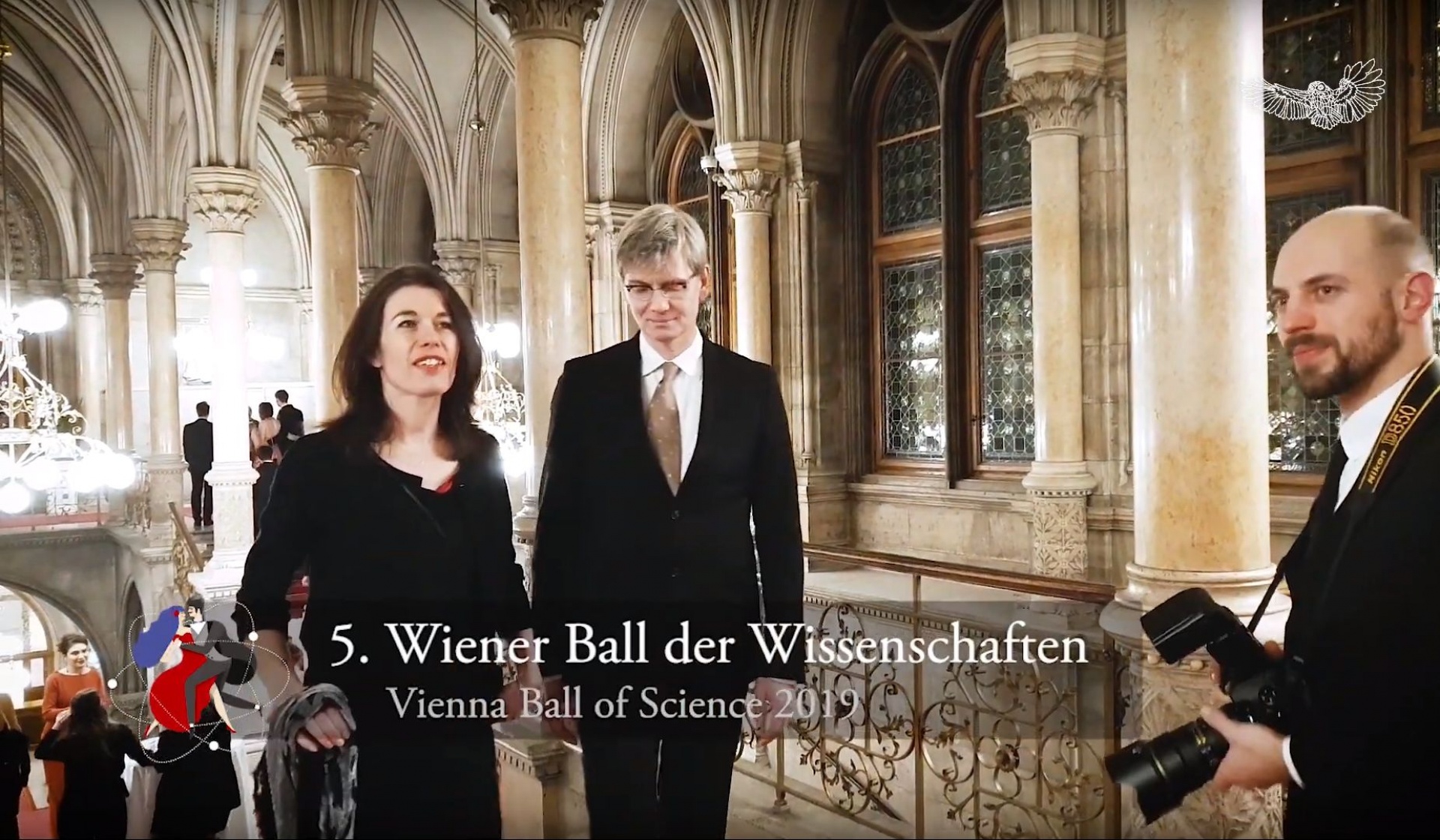
This was the Vienna Ball of Sciences 2019 - with video!

Tuesday, 05 February 2019 19:56

On the 25th of January 2019 the Vienna City Hall hosted the Vienna Ball of Sciences for the 5th time, held under the motto: “Waltz and Science". As Citizen Scientists from SPOTTERON it was a great pleasure, that we had been invited to film the event just as we did the year before.

Among the participants at the ball were scientists from all over the world. Beside others, we were able to film the Scientist of the Year Nuno Maulide, the Nobel Prize winner Robert Huber (Chemistry 1988), as well as many other well-known scientists swinging their dancing legs. The different backgrounds of the guests, the incomparable ambience of the Vienna City Hall and, last but not at least, the extremely varied programme of the ball made this evening an unforgettable experience for us.
As Citizen Scientists we were very happy to participate in an event, where beside wild dances, great music with dance interludes and the great ambience, everything was about science.

After we had prepared our equipment, the evening started, as in the last year, with the reception on red carpet of many well-known, but also new faces. After the official inauguration of the evening with speech by the chairman of the ball committee, Oliver Lehmann, and a speech of the mayor Dr. Michael Ludwig, the young ladies and gentlemen from the dance academy Kraml danced into the ceremonial hall, in order to inaugurate the evening with their Polonaise.
Afterwards we accompanied mayor Dr. Michael Ludwig and the former mayor Dr. Michael Häupl, biologist and president of the WWTF ("Viennese Science-, Research- und Technology-Fund"), on their tour through the different stages of the ball. There is one thing we could be certain about: The visitors of the Ball were definitely not bored during dance breaks on this evening.

The entertainment and presentations ranged from tasty samples of local superfoods, selected by Karl-Heinz Wagner, Professor of Nutrition Science at the University of Vienna, 3D-projections of the Vienna Center or Logic and Algorithms of the TU Vienna, virtual walks through the magical gardens of Gustav Klimt, made possible by the “Museum für Angewandte Kunst” MAK in cooperation with the multimedia artist Fred Baker, trough to a roulette table of the Casino Austria benefitting the refugee project “MORE”.

Midnight Interlude

At 00:00, Kalyi Jag, the most legendary Roma band in Hungary, presented by Ursula Hemetek, winner of the Wittgenstein Prize and ethnomusicologist, firing up the guests in the ceremonial hall.
After this moody concert the evening continued with the midnight quadrille, where even the not so enthusiastic dancers among the guests could not avoid to get up to join the dancing crowd. Due to the wonderful music of the Orchestra of the Private University for Music of Vienna and the Ball Orchestra Divertimento Viennese, nomerous couples remained on the dance floor and turned the ceremonial hall into a colourful sea of swinging ball robes and dancing legs floating above the floor.

We experienced an incredible atmosphere at 1:00 a.m. in the discotheque, when the Viennese rap-duo ESRAP made the crowd at Volkshalle, designed by students of the Academy of Fine Arts Vienna with a 30 meter long fluorescent painting, bouncing to their vibes.
Even we, the Citizen Science team from SPOTTERON, struggled very hard to stand still while trying to hold our cameras focussed.
We didn’t grab just the dancing mayor Dr. Michael Ludwig, but also the ball ambassador Prof. Franz Kerschbaum, Professor for Astronomy at the University of Vienna, who was looking for the hottest dancers with his thermal imaging camera, while swinging their dancing legs.
After raging applause and an encore the party went on with some cool music from the Djs.

Our video clip of the 5. Vienna Ball of Sciences:

When we stepped out through the gates of the town hall at the end of the evening, a waiter passed by with a beverage trolley, creating a sound comparable to disco beats. Immediately some visitors who had just left the party started to applaud: “Encore, encore, let's dance a little bit more!", we were probably not the only ones for whom this wonderful evening has gone by too soon. With anticipation we are now looking forward to the 6th Vienna Ball of Science on 25. 1. 2020. Until then we let our official ball video carry us back to the ball and float in memories.

Projects & Apps open for Co-Use on SPOTTERON

App Icon
Social initiative Data Collection App
SPOTTERON

ArtSpots is a community-built art atlas. Through the App, people interested in various art forms like street art, historical or contemporary art, photography, architecture, and more can put their art observations on the map and discover art spots in their city or while travelling. The art community in the App allows exchanging with other like-minded people and contributing to a worldwide art collection.
Learn more about
ArtSpots
App Icon
Horizon Europe Citizen Science App

With the COSEA App, Citizen Scientists can observe marine environments, document coastal habitats or species, and report on pollution, infrastructure and the blue economy. Their contributions on the map and activity in the app will help scientists better understand the impacts and drivers of marine factors to protect and foster a healthy relationship between humans and seas.

Learn more about
COSEA | Collaboration for Effective Sea Action
App Icon
Environmental Citizen Science, Data Collection App
SPOTTERON

NatureSpots is a non-commercial and free project to discover nature together. In the app, nature photos and sightings of animals, plants or mushrooms can be shared with the community on the map. The app is a new initiative for observing nature and taking part is very simple and straightforward. The app is free of advertising, does not track users and takes digital privacy seriously.

Learn more about
NatureSpots
App Icon
Social initiative Community Engagement App
SPOTTERON

The new citizen participation uses "Citizen Science" in their hometown and nationwide to get User's feedback on places. As a result, citizens are empowered to become active in a city worth living in to collect and share data themselves and to interact with scientists. This enables them to recognize the consequences of sealing, heat, water shortages, and a lack of biodiversity, and generally, how places in their own environment affect us all.

Learn more about
CIVO Citizen Voice
App Icon
Horizon 2020 Invasive Species Monitoring App

The IPM-Popillia Horizon 2020 project aims to address the challenge of a new risk to plant health in Europe's agriculture and food safety: the invasion of the Japanese Beetle, Popillia japonica. This invasive species was introduced accidentally to mainland Europe in 2014 and can quickly spread by transportation and trade. As a species with a wide range of feeding plants, P. japonica threatens the entire agricultural sector, urban landscapes, and biodiversity in invaded areas.

Learn more about
IPM Popillia | Integrated Pest Management of the Japanese Beetle
App Icon
Environmental Community Engagement App

Fridays for Future see itself as a horizontal, grassroots grassroots movement that acts apolitically and refers to science for the facts. To engage the global population more, this app was developed using SPOTTERON. The aim is to find out how the population perceives the climate crisis and which positive and negative emotions are associated with specific topics related to biodiversity and climate crisis.

Learn more about
FRIDAYS FOR FUTURE - Climate App

Are you interested in co-using existing Apps? Get in Contact!

Get in contact for co-use here


Short News

  • New study from BiciZen project: "BiciZen: Lessons in the Development of a Crowdsourcing Mobile App to Make Cities More Bikeable" published in Journal of Participatory Research Methods. More studies available under the publication page here.

    in Shortnews
  • Roadkill project has made wonderful short videos for the citizen scientists! The videos include the Roadkill App functions regarding how to confirm & comment on the spots and how to best take the photos for the project. The videos (in German) are available in the "Österreich forscht" blog here. 

    in Shortnews

Newsletter

Please enable the javascript to submit this form