Turning off the lights: a new "Night mode" in Citizen Science apps for observations from dusk till dawn

Sunday, 03 February 2019 20:28

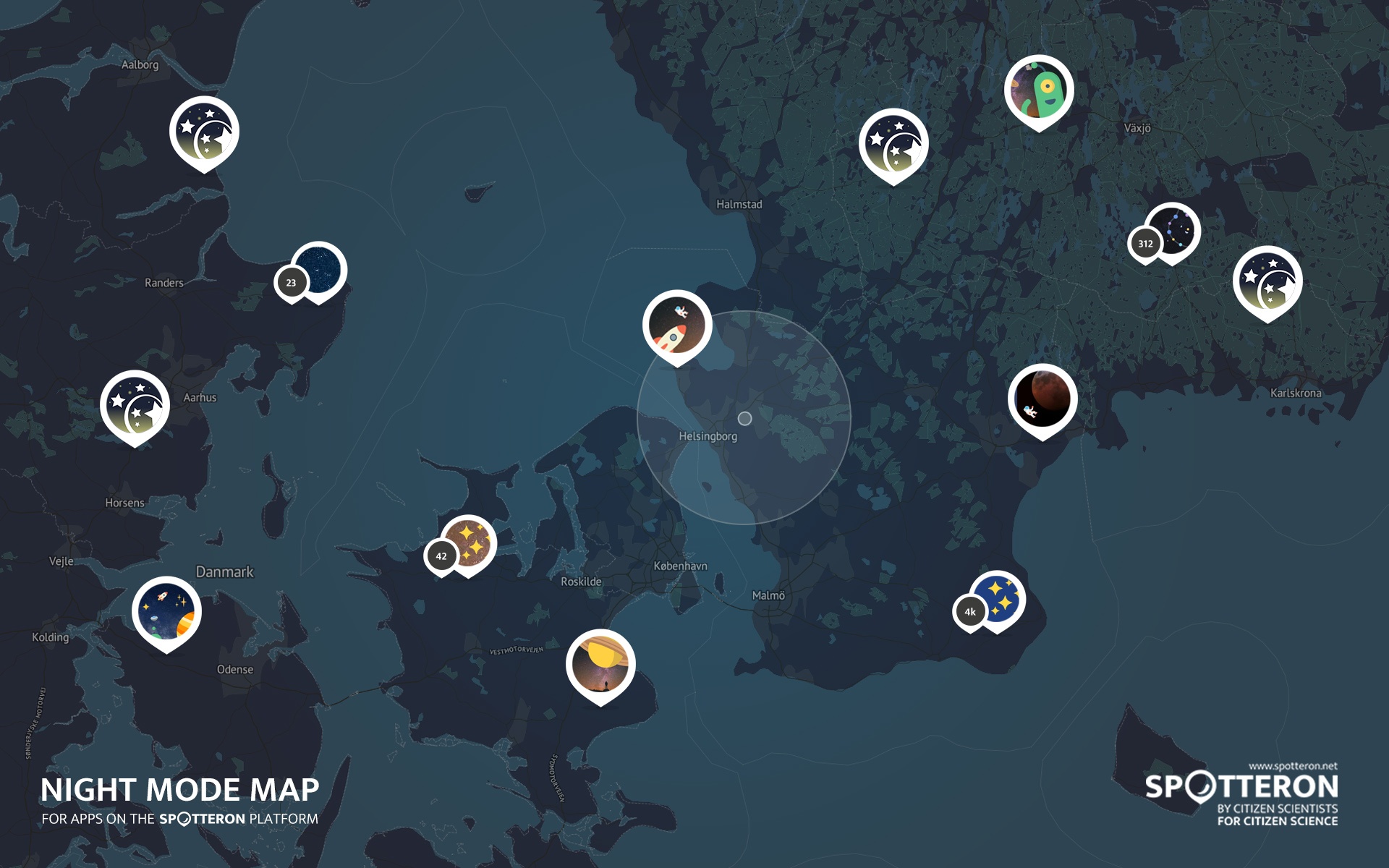
Sometimes, Citizen Science contributions are happening long after the sun has set. To reduce the blinding effect of a smartphone display, we have included a new night mode option for all Citizen Science apps on the SPOTTERON platform.

In some projects, contributions in the Citizen Science apps happens during dawn or even when the sun has already set. In the new "Stjärnförsöket" project, Citizen Scientists point a cardboard tube in all directions and count how many stars are visible to the bare eye. By that method, developed by researcher Urban Eriksson from the physics and astronomy department of Lund University in Sweden, it is possible to calculate the level of light pollution at the location and time. The project is part of the Horizon 2020 funded program "Forskar Fredag" and also part of the upcoming European Researcher's Night by the European Commission. The project is coordinated by the Swedish non-profit organisation Vetenskap & Allmänhet (Public & Science), VA.

Since smartphone displays have strong back-lighting for bright color display, the eye will adopt to that brightness when using a Citizen Science app at night for an observation in a dark environment. This can result in wrong observations, or at least will reduce the usability of such an app since a observer will have to wait a period of time until his or her eye is used to the dark surroundings again for making a new observation. To counteract this effect, we have designed a new feature on the SPOTTERON platform for Citizen Science apps, which as always is now ready to be used by all other projects on the platform without additional development costs: the new night mode.

A new map and dark color scheme for night based Citizen Science

The whole app is based on a dark color scheme, which offers black or dark gray backgrounds with fonts and interactive elements in brighter colors. In addition to the interface, we designed a new map layout on our map server infrastructure, which provides a dark map version for the app. With the new night mode, Citizen Science projects in the area of astronomy, nocturnal animal monitoring or other have an optimized interface present which can highly increase the effective use of the Citizen Science app in the field.
SPOTTERON Feature: Night Mode for Citizen Science apps

Stickers in Citizen Science apps: creative content for unique images

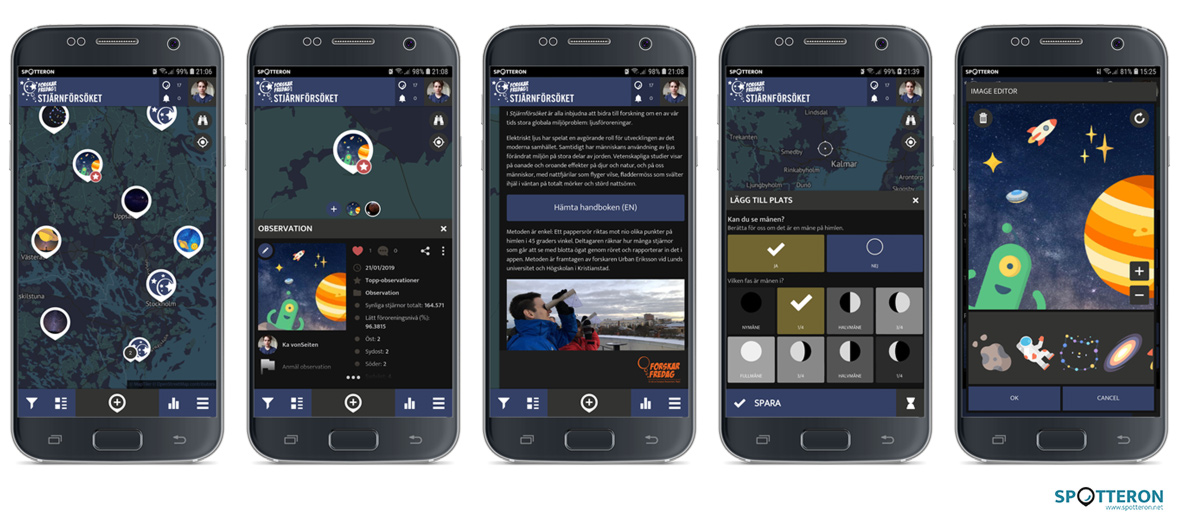
In addition, we invented an extended application of the built-in image editor, which has the possibility to add so called custom "stickers" to the picture of an observation. In all Citizen Science apps on the SPOTTERON platform, users can take a picture with their smartphone while adding the data of the spot. Since photographs at night have low detail, noise and are in general not very useful for identifying details or objects, we created a unique approach in Citizen Science to let the users have fun with their generated content and provide still photographs with variation for the spot previews in the app and e.g. social media sharing.

The image editor in Stjärnförsöket features a set of 36 cool sticker images, which can be placed in the photographs of the dark night sky in a way every smartphone app user is already familiar with from chat apps like Signal, WhatsApp or from social media platforms like Instagram or Facebook. These stickers greatly improve the uniqueness of the spots and add a new level of fun to participating in a Citizen Science project. Here are some creations from the test phase:
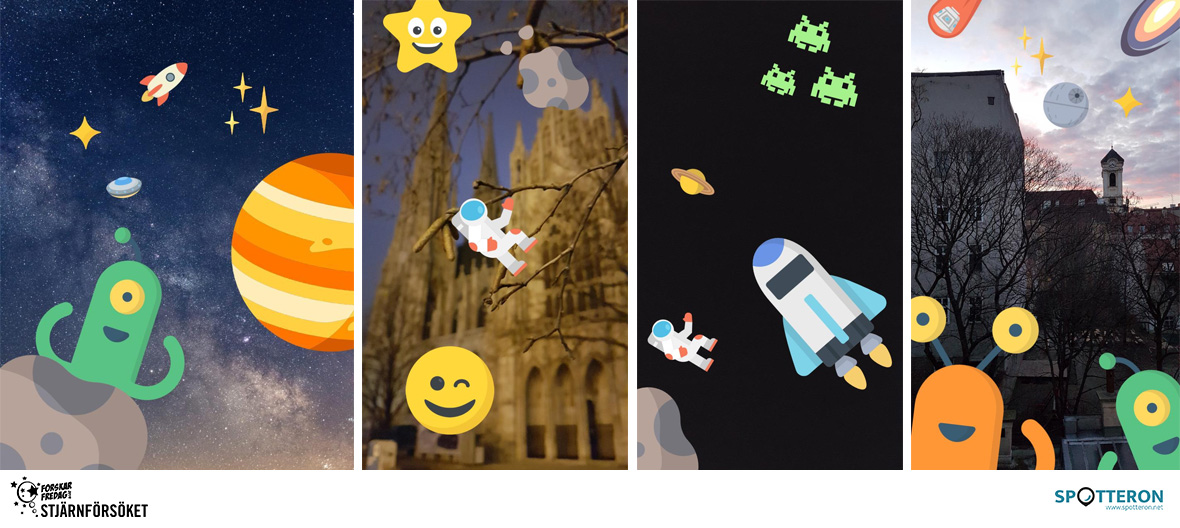
SPOTTERON Feature: Stickers in Citizen Science Apps

It is great to see an already existing feature being used creatively in another way, The "stickers" functionality has been contributed by the Citizen Science project "Crowdwater" by the University of Zurich, Switzerland for putting measurement scales in the pictures of streams and rivers to add a reference point system for ongoing water level observations. In Stjärnförsöket, the stickers are now used as a long-term motivation asset and to create visual diversity in the Citizen Science app.

The project's apps for Android and iOS are available here in the app stores:
Android: https://play.google.com/store/apps/details?id=com.spotteron.stjarnforsoket
iOS: https://itunes.apple.com/us/app/stj%C3%A4rnf%C3%B6rs%C3%B6ket-spotteron/id1450415974


Projects & Apps open for Co-Use on SPOTTERON

App Icon
Social initiative Data Collection App
SPOTTERON

ArtSpots is a community-built art atlas. Through the App, people interested in various art forms like street art, historical or contemporary art, photography, architecture, and more can put their art observations on the map and discover art spots in their city or while travelling. The art community in the App allows exchanging with other like-minded people and contributing to a worldwide art collection.
Learn more about
ArtSpots
App Icon
Horizon Europe Citizen Science App

With the COSEA App, Citizen Scientists can observe marine environments, document coastal habitats or species, and report on pollution, infrastructure and the blue economy. Their contributions on the map and activity in the app will help scientists better understand the impacts and drivers of marine factors to protect and foster a healthy relationship between humans and seas.

Learn more about
COSEA | Collaboration for Effective Sea Action
App Icon
Environmental Citizen Science, Data Collection App
SPOTTERON

NatureSpots is a non-commercial and free project to discover nature together. In the app, nature photos and sightings of animals, plants or mushrooms can be shared with the community on the map. The app is a new initiative for observing nature and taking part is very simple and straightforward. The app is free of advertising, does not track users and takes digital privacy seriously.

Learn more about
NatureSpots
App Icon
Social initiative Community Engagement App
SPOTTERON

The new citizen participation uses "Citizen Science" in their hometown and nationwide to get User's feedback on places. As a result, citizens are empowered to become active in a city worth living in to collect and share data themselves and to interact with scientists. This enables them to recognize the consequences of sealing, heat, water shortages, and a lack of biodiversity, and generally, how places in their own environment affect us all.

Learn more about
CIVO Citizen Voice
App Icon
Horizon 2020 Invasive Species Monitoring App

The IPM-Popillia Horizon 2020 project aims to address the challenge of a new risk to plant health in Europe's agriculture and food safety: the invasion of the Japanese Beetle, Popillia japonica. This invasive species was introduced accidentally to mainland Europe in 2014 and can quickly spread by transportation and trade. As a species with a wide range of feeding plants, P. japonica threatens the entire agricultural sector, urban landscapes, and biodiversity in invaded areas.

Learn more about
IPM Popillia | Integrated Pest Management of the Japanese Beetle
App Icon
Environmental Community Engagement App

Fridays for Future see itself as a horizontal, grassroots grassroots movement that acts apolitically and refers to science for the facts. To engage the global population more, this app was developed using SPOTTERON. The aim is to find out how the population perceives the climate crisis and which positive and negative emotions are associated with specific topics related to biodiversity and climate crisis.

Learn more about
FRIDAYS FOR FUTURE - Climate App

Are you interested in co-using existing Apps? Get in Contact!

Get in contact for co-use here


Short News

  • New study from BiciZen project: "BiciZen: Lessons in the Development of a Crowdsourcing Mobile App to Make Cities More Bikeable" published in Journal of Participatory Research Methods. More studies available under the publication page here.

    in Shortnews
  • Roadkill project has made wonderful short videos for the citizen scientists! The videos include the Roadkill App functions regarding how to confirm & comment on the spots and how to best take the photos for the project. The videos (in German) are available in the "Österreich forscht" blog here. 

    in Shortnews

Newsletter

Please enable the javascript to submit this form